

Electronic signature company DocuSign (NASDAQ:DOCU) reported Q2 CY2026 results exceeding the market’s revenue expectations, with sales up 9.4% year on year to $875.7 million. The company expects next quarter’s revenue to be around $888 million, close to analysts’ estimates. Its non-GAAP profit of $1.16 per share was 6.8% above analysts’ consensus estimates.
Is now the time to buy DocuSign? Find out by accessing our full research report, it’s free.
DocuSign (DOCU) Q2 CY2026 Highlights:
- Revenue: $875.7 million vs analyst estimates of $867.6 million (9.4% year-on-year growth, 0.9% beat)
- Adjusted EPS: $1.16 vs analyst estimates of $1.09 (6.8% beat)
- Adjusted Operating Income: $276.8 million vs analyst estimates of $260.6 million (31.6% margin, 6.2% beat)
- The company slightly lifted its revenue guidance for the full year to $3.50 billion at the midpoint from $3.50 billion
- Operating Margin: 13.4%, up from 8.1% in the same quarter last year
- Free Cash Flow Margin: 33.8%, down from 34.9% in the previous quarter
- Market Capitalization: $12.49 billion
"Docusign is raising its outlook as AI accelerates momentum across the business," said Allan Thygesen, CEO of Docusign. "We said IAM would be the agreement system of action, and this quarter we delivered. Our AI agents are now securely executing contract workflows end-to-end, and the IAM platform also ingested a record volume of agreements."
Company Overview
Creating the digital equivalent of "sign on the dotted line" for over a billion users worldwide, DocuSign (NASDAQ:DOCU) provides an agreement management platform that enables businesses to electronically prepare, sign, and manage documents and contracts.
Revenue Growth
Reviewing a company’s long-term sales performance reveals insights into its quality. Even a bad business can shine for one or two quarters, but a top-tier one grows for years. Over the last five years, DocuSign grew its sales at a 13.4% compounded annual growth rate. Though this growth is acceptable on an absolute basis, we need to see more than just topline growth for the software sector, which can display significant earnings volatility. This means our bar for the sector is particularly high, reflecting the non-essential and hit-driven nature of the products and services offered. Additionally, five-year CAGR starts around Covid, when revenue was depressed then rebounded.
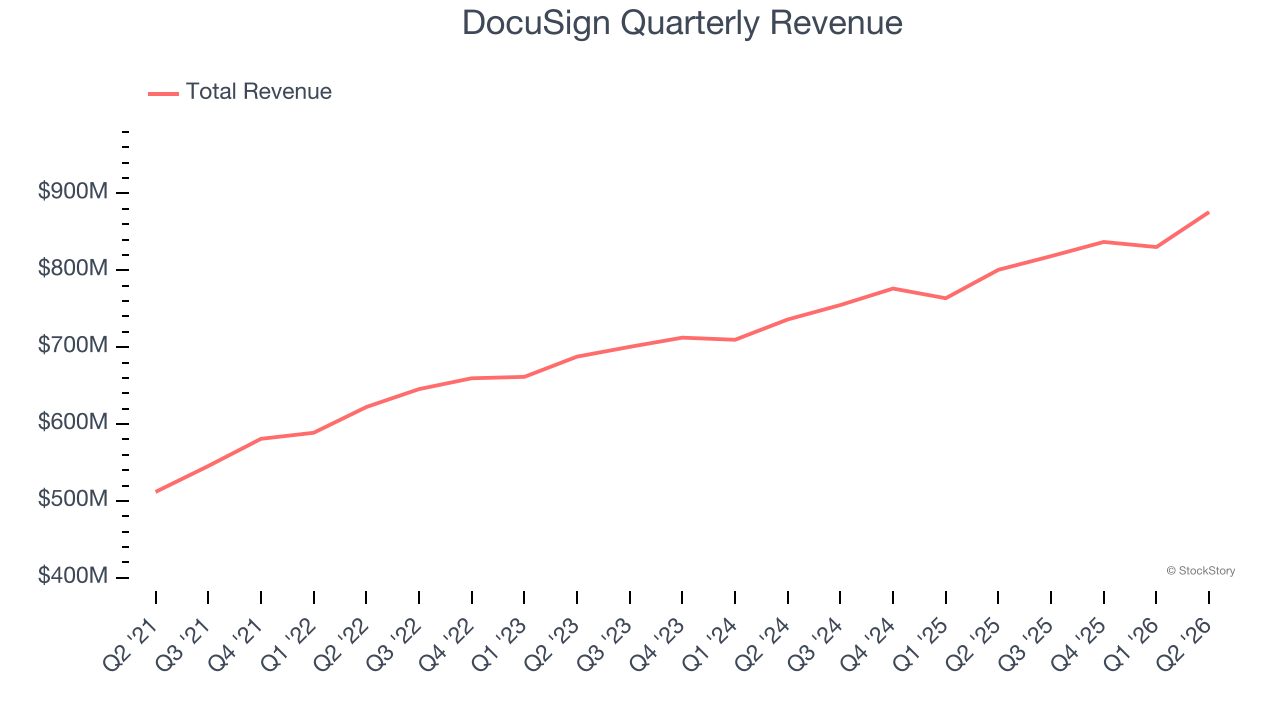
We at StockStory place the most emphasis on long-term growth, but within software, a half-decade historical view may miss recent innovations or disruptive industry trends. DocuSign’s recent performance shows its demand has slowed as its annualized revenue growth of 8.4% over the last two years was below its five-year trend. We’re wary when companies in the sector see decelerations in revenue growth, as it could signal changing consumer tastes aided by low switching costs. 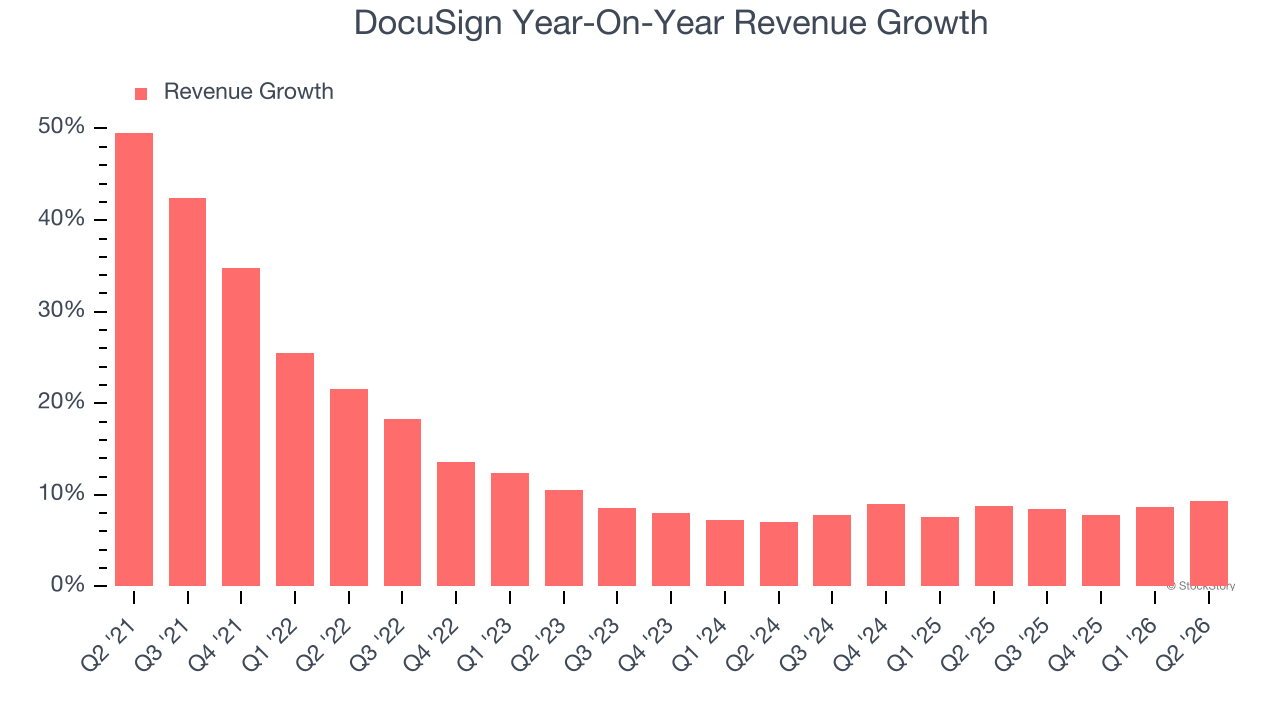
This quarter, DocuSign reported year-on-year revenue growth of 9.4%, and its $875.7 million of revenue exceeded Wall Street’s estimates by 0.9%. Company management is currently guiding for a 8.5% year-on-year increase in sales next quarter.
Looking further ahead, sell-side analysts expect revenue to grow 7.7% over the next 12 months, similar to its two-year rate. This projection doesn’t excite us and implies its newer products and services will not lead to better top-line performance yet.
ONE MORE THING: The $21 AI Application Stock Wall Street Forgot. While Wall Street obsesses over who’s building AI, one company is already using it to print money. And nobody’s paying attention.
AI chip stocks trade at ridiculous valuations. This company processes a trillion consumer signals monthly using AI and trades at a third of the price. The gap won’t last. The institutions will figure it out. You need to see this first. Read the FREE Report Before They Notice.
Customer Acquisition Efficiency
The customer acquisition cost (CAC) payback period represents the months required to recover the cost of acquiring a new customer. Essentially, it’s the break-even point for sales and marketing investments. A shorter CAC payback period is ideal, as it implies better returns on investment and business scalability.
DocuSign’s recent customer acquisition efforts haven’t yielded returns as its CAC payback period was negative this quarter, meaning its incremental sales and marketing investments outpaced its revenue. The company’s inefficiency indicates it operates in a highly competitive environment where there is little differentiation between DocuSign’s products and its peers.
Key Takeaways from DocuSign’s Q2 Results
We enjoyed seeing DocuSign beat analysts’ adjusted operating income expectations this quarter. On the other hand, its revenue guidance for next quarter was in line. Overall, this print had some key positives. The stock traded up 7.7% to $71.24 immediately following the results.
Indeed, DocuSign had a rock-solid quarterly earnings result, but is this stock a good investment here? When making that decision, it’s important to consider its valuation, business qualities, as well as what has happened in the latest quarter. We cover that in our actionable full research report which you can read here (it’s free).